Tenerife could suffer a worse catastrophy than the Indian Ocean (2004 Tsunami)
Although the locals are often reluctant to admit it, Tenerife has one of the highest population densities in the world. When people talk of what life is like in Japan, Singapore, or Hong Kong, it probably never occurs to them that Tenerife is well on its way to overtaking them when it comes to the number of people packed into a small area.
The island covers some 2000 square kilometres and the resident population is currently around 800,000. If we add tourists and other visitors, there are around a million people on the island at any one time. This works out at 500 people per square kilometre.
Let's compare this figure with those for the countries around the Indian Ocean affected by the recent tsunami:
| Country | Population density (people per sq. km) |
| Malaysia | 70 |
| Indonesia | 120 |
| Thailand | 127 |
| Ceylon (Sri Lanka) | 298 |
| India | 318 |
| Maldive Islands | 1030 |
| Tenerife | 500 |
Only the Maldive Islands have a higher population density than Tenerife. However, these are averages - population densities in the coastal regions of the affected countries can reach 1000 people per square kilometre.
If we take Tenerife's Teide National Park out of the reckoning, together with the Anaga and Teno forests (totalling 880 square kilometres, and home to barely 4000 people), we are left with just 1200 square kilometres. Re-doing the sum, we obtain a real population density of 900 per square kilometre - close to the density found in the Maldive Islands. In fact, there are municipalities such as Puerto de la Cruz, where the population density exceeds 7000 people per square kilometre.
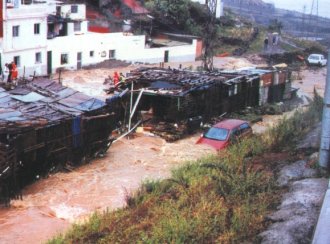
|
| Flash flood in Santa Cruz de Tenerife. 31st of March 2002. |
The chances of a Tsunami as big as the one in the Indian Ocean are fairly low (although that was also true of the one in Sumatra). [University College London has explored a likely scenario for a tsunami in the Canary Islands, which was covered in a BBC documentary]. Both the danger of a mega-tsunami and of a major eruption, while they should not be ignored, need to be seen in the context of much more likely threats.
The flash floods that tore through Santa Cruz only killed eight people but affected almost 300,000 inhabitants in the area and caused massive destruction. In this case, the authorities were lucky - the death toll would have been a great deal higher if the flood had not happened on a Bank Holiday Sunday when many people were still away. If, instead, the flood had happened on a Monday morning or during Carnival, the chances are the streets would have been filled with floating corpses - many of them tourists.
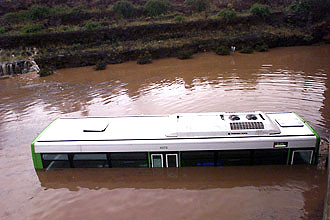
|
| Flash flood in Santa Cruz de Tenerife. 31st of March 2002. |
Another ever-present danger is the oil refinery. ATAN has repeatedly denounced the various spills and emissions from the plant over the last few years. The CEPSA oil company is keen to have us believe that everything in the garden (or in this case, the refinery) is rosy now that it has obtained the ISO 14000 certification. But if the company cannot even control its refinery emissions and oil spills, what chance does it stand of dealing with a major fire? Spanish "laissez-faire" and the island's seismological history both weight the scales in favour of the grim reaper. Why is there still no public evacuation plan for the city in the event of large refinery fire? Why is the Meridiano shopping centre sited just 30 metres away from this ticking time-bomb?
Over 100,000 people live within a 5 kilometre radius of the refinery, with no way out if disaster strikes. The city is a giant rat trap, given that both the north and south-bound highways pass bang next to the refinery and would be the first roads to be cut. The fact is, thousands of people are living next to extremely dangerous industrial facilities. Who in their right mind would site: a trade fair; various shopping centres and department stores; an auditorium; a seaside park; a major road tunnel; and a 34-storey block of flats just yards away from a 70-year old oil refinery and LPG tanks? The answer is no one - but then the ability of Tenerife's lunatic politicians to turn a blind eye to looming disaster would do credit to the rulers of a Banana Republic.
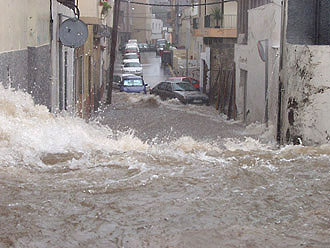
|
| Flash flood in Santa Cruz de Tenerife. 31st of March 2002. |
But even more repulsive is the way the local authorities are currently rubbing their hands with glee and publicly stating that the tsunami that hit Thailand, Indonesia, etc. can only benefit the Canary Islands. They obviously believe that it is an ill wind (or in this case, an ill tsunami) that blows nobody good. Meanwhile, the radio stations supporting the parties in power in Tenerife flood the air-waves as they ram the message home. This is particularly tasteless, when one considers that up to 100,000 people have perished around the shores of the Indian Ocean. Having the competition knocked out of the reckoning by the Forces of Nature means our glorious leaders can put off the evil day when they finally have to face the music for inflicting decades of environmentally unsustainable mass tourism on the Canary Islands.
Just to repeat the message - Santa Cruz needs an emergency plan to deal with a major refinery fire and it needs it now.
30th December 2004
 Versión española
 Versione italiana
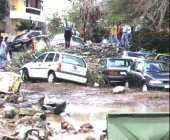 Flash flood in Santa Cruz (31st of March 2002) |
Go to...