Egyptian Bats unleashed by Loro Parque
Today's [22nd December 2004] "Opinión de Tenerife" newspaper features an interesting item - The Tenerife government is going to spend ?120,000 to eradicate the Egyptian Bat (Roussettus aegyptiacus), a foreign species that threatens native bats and insects (and by extension, the island's unique flora).
We published an article on this species in our web site (May 2003). In that article, we pointed out that: (1) the Egyptian Bat has been found in both North and South Tenerife; (2) the species poses a serious threat to native bats and thus to the island's biodiversity; (3) the Egyptian Bat's feeding habits menace Tenerife's agriculture.
We also sent a letter to the Canary Islands Ministry of Agriculture, asking where the bats had come from. In theory at least, Tenerife's "zoos" are under the Ministry's wing. It was a reasonable enough request, given that there was no way in hell that the bats could have flown from Egypt to Tenerife.
We finished our web article with the following words: "It makes no sense for the Canary Islands' government to ask for new powers when it is so patently incapable of exercising those it already has. The Executive continues to witter on about the island's bio-diversity without lifting a finger to protect it [...].?
In the aforementioned newspaper article, the government finally owned up to the dark secret kept from us by the Ministry of Agriculture the year before. The belated admission read "The Tenerife Government wishes to state that the bats were accidently released by Loro Park some two years ago.?
In other words, Loro Park is responsible for the latest threat to Northern Tenerife's biodiversity. The other "zoos" in the South (?Tenerife Zoo? and ?Águilas del Teide") are also doing their bit to upset the delicate Balance of Nature. You only have to see the escaped vultures wheeling over the Arona football ground to see how seriously the government takes its environmental responsibilities. The fact that many of our politicians' remain unruffled by the vultures' presence (and vice versa) may stem from some mysterious mutual affinity.
Last Monday (20th December 2004), the Official Gazette published a toadying article titled "Loro Parque to spend half a million Euros on protecting parrots in their native habitats", and generally sang the praises of the park. Such generosity has precedents. Some readers will no doubt recall the $ 100,000 contribution showered by former Loro Parque Curator, Tony Silva, on the US courts by way of a fine (accompanied by a stiff gaol sentence) [source: World Wildlife Fund, UK]. The Americans, it seems, take industrial-scale parrot smuggling seriously. While the park pays parrot protection money in Indonesia, it pecks the hand that feeds it in Tenerife by unleashing Egyptian Bats on the Island's long-suffering habitat. It is ironic that Loro Parque is allowed to feather its nest with tourist dollars while the government chickens out of getting to grips with the firm. Instead of spending ? 120,000 of public money on a wild bat chase, it could do with clipping Loro Parque's wings.
Loro Parque should pay for eradicating the Egyptian Bat and show that it is really committed to conservation. Despite the park's endless parroting of the "conservationist" message, Loro Parque is just another theme park showing off animals in confined spaces. Chimpanzees, assorted primates, tigers, dolphins, sea lions, penguins (and soon, killer whales) are simply attractions. The thousands of gormless tourists that go to the daily shows are simply grist to Herr Wolfgang Kiessling's money-making mill.
An increasing number of parrots are to be found in the Orotava Valley and we have a pretty shrewd idea where they came from. We have spotted parrots that are so exotic it has proven impossible to identify them. They have cropped up in places as far afield as Playa de Los Patos ["Duck Beach"!], and Caldera de la Orotava. When ATAN made an "official" visit to Loro Parque some ten years ago, there were parrots flying free. There were even posters at the foot of some of the palms indicating the parrot species living in each tree. The signs have since disappeared and it is anyone's guess where the parrots are now.
In March the Press also published an article on exotic butterflies that had escaped from Icod. Such irresponsible management, whether private or public, ends up harming the environment. It is the same old story - those responsible soar free (unless, like Tony, they stray abroad) while taxpayers' money is frittered away in damage-limitation exercises.
Despite the gravity of the situation, the Tenerife's Minister of the Environment made the following batty remark in the newspaper article: ?everything is under control and the experts will soon capture and eradicate the beasts". We were told that Fountain Grass was "under control" too. If the Island's government had imposed the same point-of-entry controls employed by more enlightened archipeligos, the taxpayer would have been saved fruitless multi-million dollar eradication campaigns. When it comes to environmental management, Tenerife's whitewashing politicians are an utter washout.
All in all, the island's rulers seem much keener on cure than prevention, maybe because it provides a wonderful pretext for spending millions of taxpayer dollars and creaming off something along the way. Meanwhile, Tenerife's unique fauna and flora are succumbing to Man's greed and the government's wilful neglect of the environment.
24th December 2004
 Versión española
 Versione italiana
 Tenerife |
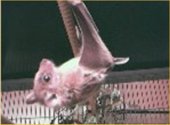 Roussettus aegyptiacus - The Bat out of Hell (well, actually out of Loro Park) |
Go to...